BUYERS GUIDE · Health & Wellness / GLP-1 & Weight Loss
Semaglutide vs. Tirzepatide: What's the Difference? Ozempic, Wegovy, Mounjaro & Zepbound Explained
Semaglutide or tirzepatide? Compare weight loss results, side effects, costs, and the key differences between Ozempic, Wegovy, Mounjaro, and Zepbound.
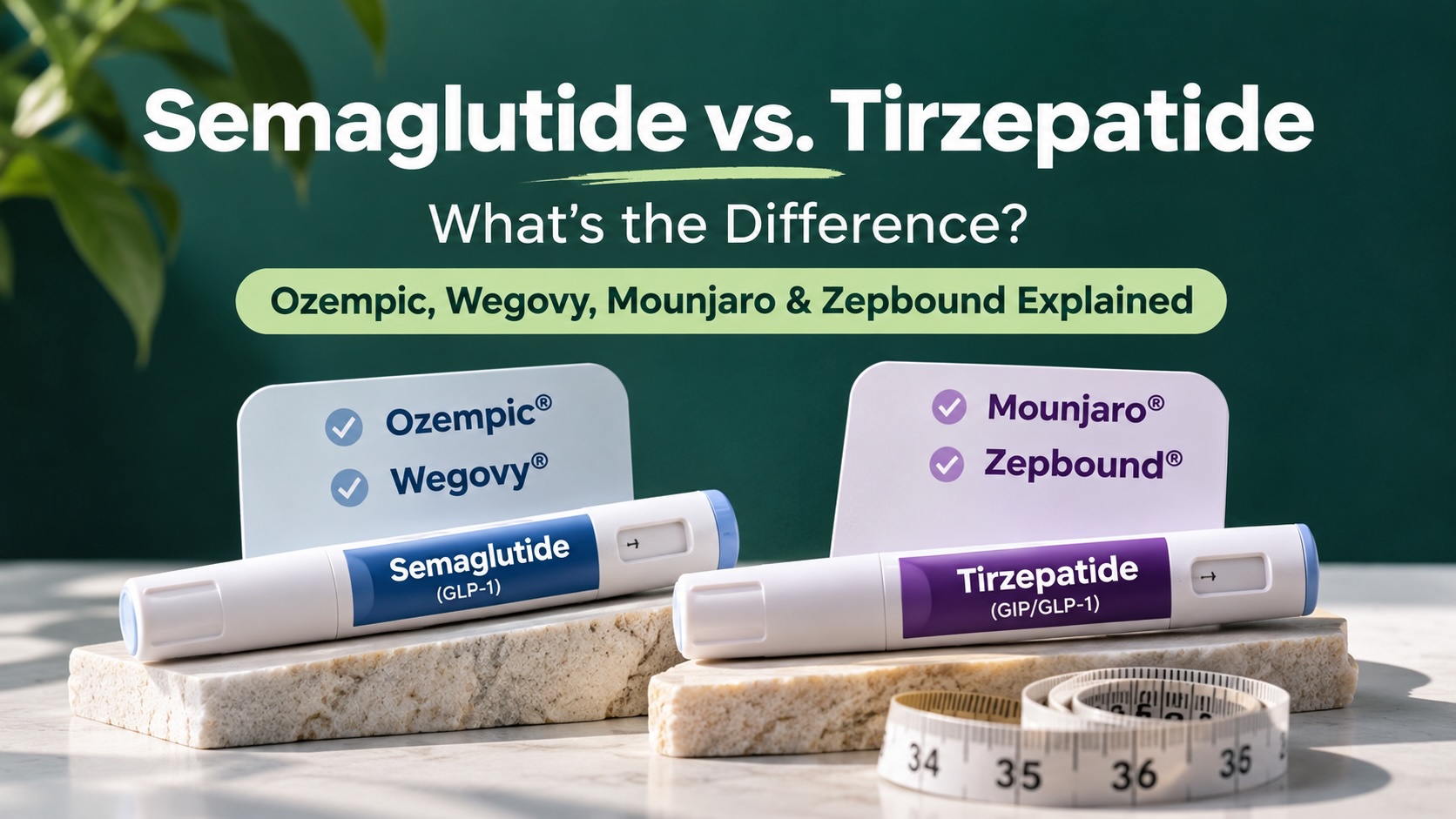
Two of the most talked-about medications for weight loss are semaglutide and tirzepatide. But how do they actually compare, and what makes one different from the other?
If you've been researching medical weight loss, you've probably encountered names like Ozempic, Wegovy, Mounjaro, and Zepbound. While these medications are often discussed together, they aren't interchangeable, and their FDA-approved uses aren't identical.
In this guide, we'll break down how semaglutide and tirzepatide work, what clinical studies reveal about their effectiveness, their potential side effects, and what to consider before exploring treatment.
TL;DR: Semaglutide vs. Tirzepatide
Semaglutide activates the GLP-1 receptor, helping regulate appetite, food intake, and blood sugar.
Tirzepatide activates both GIP and GLP-1 receptors, using two hormonal pathways.
Weight loss: In a 72-week head-to-head clinical trial, participants taking tirzepatide lost an average of 20.2% of their starting body weight, compared with 13.7% for semaglutide.
Brand names: Ozempic and Wegovy contain semaglutide; Mounjaro and Zepbound contain tirzepatide.
Side effects: Both can cause nausea, vomiting, diarrhea, constipation, and other gastrointestinal symptoms.
Our takeaway: Tirzepatide demonstrated greater average weight loss in the head-to-head trial, but the right medication depends on your medical history, treatment goals, tolerability, access, and clinician's assessment.
What Is Semaglutide?
Semaglutide belongs to a class of medications called GLP-1 receptor agonists.
GLP-1 is a hormone involved in regulating blood sugar and appetite. Semaglutide mimics its activity, helping people feel fuller, reducing food intake, and slowing stomach emptying.
Semaglutide is the active ingredient in several prescription medications, including:
Ozempic: Primarily used for type 2 diabetes, with additional approved indications for certain patients. Although weight loss can occur during treatment, Ozempic is not specifically FDA-approved for weight management.
Wegovy: Approved for chronic weight management in eligible patients and for certain additional indications. Wegovy is available in injection and oral tablet formulations, with formulation-specific prescribing instructions.
Rybelsus: An oral semaglutide medication used for type 2 diabetes.
The important distinction is that these products may share an active ingredient but have different approved uses, formulations, and dosing schedules.
What Is Tirzepatide?
Tirzepatide works differently from semaglutide because it activates two hormone receptors rather than one.
These are:
GLP-1 (glucagon-like peptide-1): Helps regulate appetite, food intake, and blood sugar.
GIP (glucose-dependent insulinotropic polypeptide): Plays a role in insulin secretion and metabolic regulation.
This dual mechanism is why tirzepatide is often described as a dual GIP/GLP-1 receptor agonist.
Two widely recognized tirzepatide brands are:
Mounjaro: FDA-approved for type 2 diabetes.
Zepbound: FDA-approved for chronic weight management in eligible adults and for certain adults with obesity and moderate-to-severe obstructive sleep apnea.
Both contain tirzepatide, but their approved indications differ.
Semaglutide vs. Tirzepatide: Side-by-Side Comparison
Feature | Semaglutide | Tirzepatide |
|---|---|---|
Drug class | GLP-1 receptor agonist | Dual GIP/GLP-1 receptor agonist |
Common brands | Ozempic, Wegovy | Mounjaro, Zepbound |
Main mechanism | Activates GLP-1 receptors | Activates GIP and GLP-1 receptors |
Weight-management brands | Wegovy | Zepbound |
Administration | Depends on product; injections and oral formulations exist | Once-weekly injection for Mounjaro and Zepbound |
Average weight loss in SURMOUNT-5 | 13.7% | 20.2% |
Common side effects | Mainly gastrointestinal | Mainly gastrointestinal |
The weight-loss figures come from a specific 72-week study comparing weekly injectable formulations at maximum tolerated doses. They are study averages, not guaranteed individual outcomes.
Which Is More Effective for Weight Loss?
One of the strongest direct comparisons comes from the SURMOUNT-5 clinical trial, published in The New England Journal of Medicine in 2025.
The study included 751 adults with obesity, or overweight with a weight-related medical condition, who did not have type 2 diabetes.
Participants received either weekly tirzepatide or weekly semaglutide at the maximum tolerated study dose over 72 weeks.
Average Weight Loss After 72 Weeks
Medication | Average Body Weight Reduction |
|---|---|
Tirzepatide | 20.2% |
Semaglutide | 13.7% |
That represents a difference of 6.5 percentage points in average body weight reduction.
For illustration, someone starting at 220 pounds would lose approximately 44 pounds at 20.2%, compared with approximately 30 pounds at 13.7%.
These figures are mathematical illustrations of study averages, not predictions for any individual.
The trial also found greater average reductions in waist circumference among participants taking tirzepatide.
What does this mean?
Tirzepatide demonstrated superior average weight-loss efficacy in this particular trial. However, greater average weight loss doesn't automatically make it the best choice for everyone. Treatment decisions also involve medical conditions, safety, tolerability, cost, and individual response.
What About Side Effects?
Both medications affect gastrointestinal function, so their most commonly reported side effects overlap.
These can include nausea, vomiting, diarrhea, constipation, abdominal discomfort, and indigestion.
Symptoms are often more noticeable when treatment begins or doses are increased. Healthcare professionals generally use gradual dose escalation to help patients tolerate treatment.
However, both medications also carry important safety warnings.
These include risks involving pancreatitis, gallbladder disease, dehydration-related kidney injury, and severe gastrointestinal reactions.
Their US prescribing information also contains boxed warnings concerning thyroid C-cell tumors observed in rodents. Whether these drugs cause medullary thyroid carcinoma in humans is unknown. They are contraindicated for people with a personal or family history of medullary thyroid carcinoma or multiple endocrine neoplasia syndrome type 2 (MEN 2).
Patients should discuss their full medical history, current medications, pregnancy considerations, and any concerning symptoms with a licensed healthcare professional before treatment.
How Much Do Semaglutide and Tirzepatide Cost?
Pricing is one of the biggest considerations for people exploring GLP-1 treatment.
However, there isn't one universal price for either medication.
The actual cost can depend on the brand, formulation, insurance coverage, eligibility for manufacturer programs, pharmacy, and prescribing provider.
Online weight-management services may also charge separately for consultations, membership fees, ongoing monitoring, and medication.
Before signing up for any program, check what the advertised price actually includes.
A low introductory price doesn't necessarily represent the full cost of continued treatment.
What About Compounded Semaglutide and Tirzepatide?
Some online services advertise compounded versions of these medications.
It's important to understand that compounded medications are not FDA-approved and do not undergo the same FDA premarket review for safety, effectiveness, and quality as approved drugs.
The FDA has raised concerns about dosing errors, adverse events, misleading marketing, and the use of unapproved ingredients in compounded GLP-1 products.
Compounding is also subject to specific legal restrictions and should not be treated as a routine substitute for an available FDA-approved medication.
Patients should use a valid prescription, verify that their pharmacy is appropriately licensed, and discuss treatment options with a qualified clinician.
Which One Should You Choose?
There isn't a universal winner for every patient.
Semaglutide may be worth discussing when its approved indications, available formulations, clinical evidence, or individual treatment considerations align with a patient's needs.
Tirzepatide may be worth discussing when weight-loss effectiveness is an important consideration, given its stronger average results in the SURMOUNT-5 trial.
However, the decision shouldn't be based on weight-loss percentages alone.
Your clinician may consider existing health conditions, contraindications, medication interactions, previous treatment response, side-effect tolerance, insurance coverage, and long-term treatment goals.
Both medications are intended to be used according to their approved labeling and appropriate medical supervision.
Our Take: Understanding the Medication Is Only the First Step
Semaglutide and tirzepatide have changed the landscape of medical weight management.
Both have demonstrated meaningful weight-loss benefits in clinical trials, while tirzepatide has shown greater average weight reduction in direct comparison with injectable semaglutide.
But choosing a medication is only part of the decision.
Finding a legitimate provider, understanding the full treatment cost, verifying medication sourcing, and receiving appropriate ongoing care are equally important.
Ready to Explore Online GLP-1 Providers?
If you're considering medically supervised weight management, we've also compared six online GLP-1 providers, including their program features, pricing information, and treatment options.
Read Our Guide: 6 Online GLP-1 Providers for Weight Loss Compared
Explore the comparison before deciding which service may be worth discussing with a licensed healthcare professional.
Medical Disclaimer: This article is intended for general educational purposes only and does not constitute medical advice, diagnosis, or treatment. Prescription weight-management medications require individualized evaluation by a licensed healthcare professional. Never start, stop, combine, or change prescription medications without appropriate medical guidance.
Sources & References
Frequently Asked Questions
In the SURMOUNT-5 head-to-head trial, tirzepatide produced greater average weight loss than semaglutide after 72 weeks. That doesn't mean every individual will respond better to tirzepatide.
They contain the same active ingredient, semaglutide, but have different FDA-approved indications and product-specific dosing instructions.
Both contain tirzepatide. Mounjaro is approved for type 2 diabetes, while Zepbound has weight-management and certain sleep-apnea indications.
A healthcare professional may consider changing treatment based on clinical circumstances. Patients should not switch medications or calculate equivalent doses on their own, because the products have different dosing schedules and titration requirements.
Weight regain can occur after treatment is discontinued. Obesity is often a chronic condition, and maintaining weight loss may require ongoing medical care, nutrition, physical activity, and other long-term strategies.
ThisDealSlaps may earn a commission when you purchase through links on this page, at no additional cost to you. Product availability, pricing, and sizes may change. Always check the retailer's product page for the latest details.